Press filter is a common solid-liquid separation equipment, which is widely used in chemical industry, environmental protection, food, medicine and other fields. It separates the solid particles in the suspension from the liquid by means of pressurized filtration to achieve the purpose of purification or concentration. In this article, we will introduce the working principle and benefits of the press filter in detail, in order to better understand and apply this equipment.
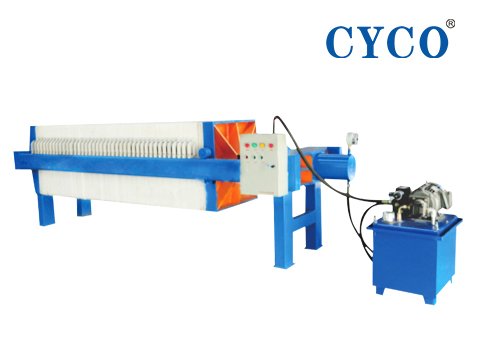
Working Principle
The working principle of the press filter is mainly divided into the following steps:
- Feeding: The suspension to be treated is fed into the filter chamber of the press filter through the feeding pump.
- Pressurizing: The filter chamber is pressurized by the hydraulic system or pneumatic system, so that the solid particles in the suspension are retained on the filter cloth, while the liquid flows out through the filter cloth.
- Filtering: During the pressurization process, the filter cloth plays the role of a filter medium, solid particles are retained on the surface of the filter cloth, forming a filter cake. As time goes by, the cake gradually thickens and the filtration resistance increases.
- Unloading: When the filter cake reaches a certain thickness or the filtration resistance reaches the set value, stop pressurizing and unload the filter cake. The unloading method can be manual or automatic, depending on the equipment configuration.
- Cleaning: In order to maintain the filter performance of the filter cloth, the filter cloth needs to be cleaned regularly. Cleaning method can be water washing, gas washing or chemical cleaning.
Benefits
- High-efficiency separation: The press filter adopts the way of pressurized filtration, which can efficiently separate solid particles from liquid, and get purer filtrate and drier filter cake.
- Energy saving and environmental protection: Compared with other solid-liquid separation equipment, the press filter has lower energy consumption and less wastewater discharge, which meets the requirements of energy saving and environmental protection.
- Easy to operate: The operation of the press filter is relatively simple, only need to control the basic steps such as feeding, pressurizing and discharging. In addition, the equipment has a high degree of automation, which can reduce the labor intensity of the operator.
- Strong adaptability: The press filter can deal with suspensions of different natures, such as high concentration, high viscosity, high temperature and so on. At the same time, different filter cloth materials and precision can be selected according to actual needs to meet different filtration requirements.
- Compact structure: The compact structure and small footprint of the press filter make it easy to install and maintain. In addition, the modular design of the equipment makes it highly expandable and can be flexibly configured according to production requirements.
- Long service life: Key components of the press filter, such as the filter cloth and hydraulic system, are made of high-quality materials with high abrasion and corrosion resistance. With proper use and maintenance, the equipment has a long service life.
Summary
As an efficient, energy-saving and environmentally friendly solid-liquid separation equipment, the press filter has been widely used in many fields. Its working principle is simple and straightforward, and solid-liquid separation is realized through pressurized filtration. The benefits are reflected in the efficient separation, energy saving, environmental protection, easy to operate and so on. Understanding the working principle and advantages of the press filter helps to better select and use this equipment, improve production efficiency and product quality.